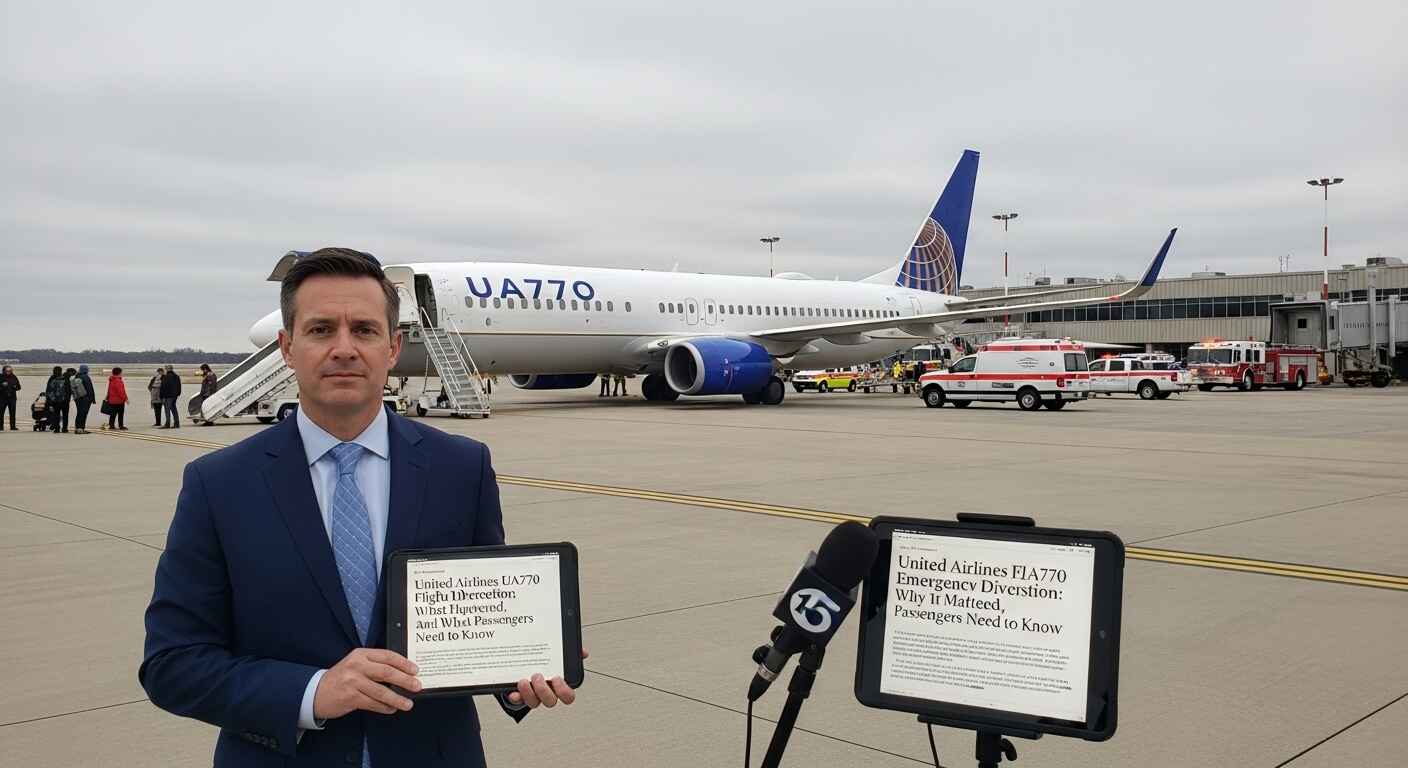
The United Airlines Flight UA770 Emergency Diversion on May 27, 2025, became one of the most talked-about aviation incidents of the summer travel season.
A Boeing 787-9 Dreamliner, registered as N26902, departed Barcelona El Prat Airport bound for Chicago O’Hare when the flight crew squawked emergency transponder code 7700 approximately 90 minutes into the flight.
Air traffic controllers rerouted the aircraft to London Heathrow Airport, where it landed safely on Runway 27R at approximately 4:55 PM BST. No injuries were reported.
United Airlines Flight UA770 Emergency Diversion Key Facts Table
| Detail | Information |
|---|---|
| Incident Name | United Airlines Flight UA770 Emergency Diversion |
| Date | May 27, 2025 |
| Flight Number | UA770 |
| Airline | United Airlines |
| Aircraft Type | Boeing 787-9 Dreamliner |
| Registration | N26902 |
| Departure Airport | Barcelona El Prat Airport (BCN) |
| Scheduled Destination | Chicago O’Hare International Airport (ORD) |
| Diversion Airport | London Heathrow Airport (LHR) |
| Emergency Code | 7700 (General Emergency) |
| Landing Runway | 27R |
| Gate | B44 |
| Landing Time | Approximately 4:55 PM BST |
| Planned Stopover | 1 hour |
| Injuries | None reported |
| Official Cause | Not publicly disclosed |
What Is the United Airlines Flight UA770 Emergency Diversion?
The United Airlines Flight UA770 Emergency Diversion refers to the unplanned rerouting of a transatlantic passenger service from its scheduled Barcelona to Chicago route to London Heathrow Airport after the flight crew declared a general emergency in European airspace.
The flight operated under United Airlines flight number UA770 and was carrying passengers on what should have been a standard non-stop transatlantic crossing. The declaration of a 7700 squawk triggered a coordinated response from air traffic control across European airspace, resulting in a priority landing at one of the world’s busiest and best-equipped international airports.
United Airlines confirmed the United Airlines Flight UA770 Emergency Diversion to aviation tracking and news outlet AIRLIVE while the aircraft was still in the air, providing real-time confirmation that a diversion to London Heathrow was underway. The airline confirmed the expected landing time of 4:55 PM BST before the aircraft touched down.
Timeline of the United Airlines Flight UA770 Emergency Diversion
Understanding the sequence of events helps clarify how quickly and professionally the situation was managed from the moment the emergency was declared.
The flight departed Barcelona El Prat Airport on the morning of May 27, 2025. Approximately 90 minutes after takeoff, while the Boeing 787-9 was still over European airspace, the flight crew activated transponder code 7700. This action immediately alerted air traffic controllers in the region to an onboard emergency requiring priority handling.
Controllers began coordinating the diversion without delay. London Heathrow was identified as the most suitable diversion airport given its proximity, its 24-hour operational capacity, and its full emergency infrastructure. Heathrow activated its standard emergency response protocols, positioning fire and rescue services along the approach path to Runway 27R.
The aircraft landed safely at approximately 4:55 PM BST on Runway 27R. After a normal deceleration and taxi, N26902 arrived at Gate B44. Passengers disembarked without incident. United Airlines indicated an initial planned stopover of approximately one hour for technical inspection.
Step-by-step timeline of the United Airlines Flight UA770 Emergency Diversion:
- Departure: Barcelona El Prat Airport, May 27, 2025
- Emergency declared: Approximately 90 minutes after takeoff over European airspace
- Transponder code activated: 7700 (General Emergency)
- Diversion decision: London Heathrow Airport selected
- Airline confirmation: United Airlines confirmed the diversion to AIRLIVE
- Landing: Runway 27R, approximately 4:55 PM BST
- Aircraft parked: Gate B44
- Passengers: Disembarked safely with no injuries reported
The Aircraft Involved in the United Airlines Flight UA770 Emergency Diversion
The Boeing 787-9 Dreamliner registered as N26902 is the aircraft at the center of the United Airlines Flight UA770 Emergency Diversion. The 787-9 is a long-range, wide-body commercial aircraft specifically designed for routes such as Barcelona to Chicago.
The aircraft uses a composite airframe construction that reduces weight and improves fuel efficiency compared to older aluminium-framed jets. Its advanced systems architecture includes redundant safety mechanisms across electrical, hydraulic, and pressurisation systems. These redundancies mean that a single system fault typically does not create an immediate danger but may trigger warning alerts that require pilot action.
United Airlines is one of the world’s largest operators of the Boeing 787 family. The 787-9 variant in particular is a cornerstone of the airline’s transatlantic and transpacific fleet. Its range of approximately 14,000 kilometres makes it ideally suited for non-stop crossings between Europe and North America.
The registration N26902 identifies this specific aircraft within the United States Federal Aviation Administration registry. Aviation tracking services such as FlightAware and AirNavRadar monitored the flight path of this aircraft throughout the United Airlines Flight UA770 Emergency Diversion, providing real-time position and altitude data to the aviation community.
What Does Squawk 7700 Mean in the Context of This Diversion?
The squawk 7700 activation is the defining technical action at the heart of the United Airlines Flight UA770 Emergency Diversion. Understanding what this code means helps explain why the response from air traffic control was so immediate and coordinated.
In civil aviation, transponder codes are four-digit numbers broadcast by an aircraft’s onboard transponder system. Air traffic controllers use these codes to identify aircraft on radar. Three specific codes carry emergency significance.
The three principal emergency transponder codes are:
- 7700 signals a General Emergency and activates priority handling for any serious onboard situation
- 7600 signals a Radio Communication Failure, indicating the crew cannot communicate normally
- 7500 signals Unlawful Interference, typically associated with a hijacking or security threat
The 7700 code used during the United Airlines Flight UA770 Emergency Diversion does not specify what type of emergency is occurring. It communicates urgency without providing the nature of the problem. This deliberately broad code is used because pilots dealing with a serious situation may not have time to relay details before activating the signal.
Once the squawk 7700 was broadcast, European air traffic controllers immediately began coordinating with United Airlines and Heathrow to prepare for the priority arrival. Emergency services at the airport moved to standby positions along Runway 27R ahead of the landing.
Why London Heathrow Was Chosen for the United Airlines Flight UA770 Emergency Diversion
The selection of London Heathrow as the diversion airport during the United Airlines Flight UA770 Emergency Diversion was not coincidental. It reflects standard decision-making protocols applied when a large wide-body aircraft declares an emergency over European airspace.
Heathrow offers several capabilities that make it one of the preferred diversion airports in Europe for long-haul aircraft. It operates continuously around the clock with full staffing across air traffic control, emergency fire and rescue, medical services, and aircraft maintenance. Its two parallel runways, including 27R used during this incident, are capable of receiving the largest commercial aircraft in operation today.
The airport also maintains comprehensive engineering and maintenance facilities that can quickly assess a diverted aircraft and begin any necessary technical work. For a Boeing 787-9 operated by United Airlines, Heathrow provides access to both Boeing-certified engineers and United’s own European maintenance support network.
Geographic position also played a role. When the United Airlines Flight UA770 Emergency Diversion was declared approximately 90 minutes after Barcelona departure, the aircraft was positioned over central European airspace within practical range of multiple airports. Heathrow’s combination of capacity, geographic accessibility, and emergency infrastructure made it the operationally superior choice.
Passenger Experience During the United Airlines Flight UA770 Emergency Diversion
For those aboard during the United Airlines Flight UA770 Emergency Diversion, the experience involved an abrupt change of destination without prior warning. Passengers expecting to complete a transatlantic crossing to Chicago found themselves landing in London instead.
In most emergency diversion scenarios, passengers are not immediately informed of the technical reason for the rerouting. Cabin crew manage the cabin environment during the approach and landing, following standard procedures to ensure passenger composure and safety. The professional handling of this particular diversion, with a smooth landing and orderly disembarkation, reflects the training standards applied across United Airlines cabin operations.
Once on the ground at Heathrow, passengers faced the practical consequences of an unplanned stop. Some faced missed connections at Chicago O’Hare. Others required rebooking onto alternative flights. United Airlines maintains a customer service infrastructure at Heathrow given its regular operations at the airport, providing passengers with rebooking assistance, meal provisions, and accommodation support where required.
Passengers traveling with United Airlines carry certain consumer protections under US Department of Transportation regulations as well as EU air passenger rights legislation that may apply, given the European departure point of this flight. Understanding those rights is important for anyone affected by a diversion of this nature.
Possible Causes Behind the United Airlines Flight UA770 Emergency Diversion
United Airlines did not publicly disclose the specific cause of the United Airlines Flight UA770 Emergency Diversion in initial reporting. This is not unusual. Airlines and aviation authorities typically conduct internal safety reviews before releasing formal incident reports to the public.
There are several categories of events that commonly lead to a mid-flight 7700 squawk on a long-haul aircraft of this type.
Technical causes that may trigger an emergency declaration include:
- Engine system alert or performance anomaly
- Cabin pressurisation warning or loss of pressurisation
- Electrical system fault or avionics warning
- Smoke or fire detection system activation
- Hydraulic system irregularity
- Environmental control system failure
Non-technical causes include:
- A serious medical emergency among passengers or crew requiring urgent ground-level medical care
- A precautionary response to a warning that cannot be diagnosed in flight
- The crew’s decision to divert while a situation remains manageable
Many emergency declarations are precautionary in nature. A flight crew facing an unresolved system alert over the Atlantic Ocean has limited options for diagnosis at cruise altitude. Choosing to divert while over Europe with multiple major airports in range is operationally sound and reflects the training principle of acting early rather than continuing into uncertainty.
The investigation into the United Airlines Flight UA770 Emergency Diversion would typically be conducted internally by United Airlines and potentially reviewed by the UK Air Accidents Investigation Branch, given the landing in British airspace.
Aviation Safety Standards and the United Airlines Flight UA770 Emergency Diversion
The United Airlines Flight UA770 Emergency Diversion unfolded exactly as the global aviation safety system is designed to handle such events. From the moment the 7700 squawk was activated to the safe landing at Heathrow, every element of the response reflected layers of protocol built around passenger safety.
Modern commercial aviation operates under a principle of redundancy and early escalation. Aircraft systems are designed with multiple backup layers so that a single point of failure does not create catastrophic results. Pilots are trained to respond to warning alerts immediately, prioritising the safety of the aircraft and everyone aboard over schedule or operational convenience.
The coordination between the crew of N26902, European air traffic control, London Heathrow emergency services, and United Airlines operations demonstrated effective international aviation safety cooperation. No passenger or crew member was harmed. The aircraft landed safely and was secured at the gate without incident.
This outcome, while specifically the result of the United Airlines Flight UA770 Emergency Diversion on May 27, 2025, is representative of hundreds of similar diversions that occur across global aviation each year. The high success rate of such events reflects the robustness of the safety framework in which commercial aviation operates.
What Passengers Should Know If Their Flight Declares an Emergency
The United Airlines Flight UA770 Emergency Diversion serves as a useful reference point for understanding what passengers can expect if their own flight declares an emergency or diverts unexpectedly.
Cabin crew will not always provide immediate, detailed explanations during an active emergency. Their priority is the safety of the cabin. Passengers should follow crew instructions without delay, remain seated with seatbelts fastened until directed otherwise, and keep calm throughout the descent and landing.
After landing, airline staff at the diversion airport will guide the next steps. Having essential items, including medication, travel documents, and phone chargers in hand luggage, is strongly advisable on any long-haul flight precisely because diversions like this one can occur without warning.
Passengers should also be aware of their rights. Those departing from an EU airport, as UA770 passengers did from Barcelona, have protections under EU Regulation 261/2004 regarding delays and diversions. US-originating passengers have protections under DOT regulations. Knowing these rights before traveling helps manage the aftermath of any disruption more effectively.
Frequently Asked Questions About the United Airlines Flight UA770 Emergency Diversion
What was the United Airlines Flight UA770 Emergency Diversion?
It was an emergency diversion of United Airlines flight UA770, a Boeing 787-9 flying from Barcelona to Chicago, that squawked 7700 and landed at London Heathrow on May 27, 2025.
When did the United Airlines Flight UA770 Emergency Diversion happen?
It occurred on May 27, 2025. The emergency was declared approximately 90 minutes after departure from Barcelona. The aircraft landed at Heathrow at approximately 4:55 PM BST.
What emergency code was used during the United Airlines Flight UA770 Emergency Diversion?
The flight crew squawked transponder code 7700, which signals a general emergency requiring priority handling from air traffic control.
Was anyone hurt during the United Airlines Flight UA770 Emergency Diversion?
No injuries were reported among passengers or crew following the diversion and safe landing at London Heathrow.
What aircraft was involved in the United Airlines Flight UA770 Emergency Diversion?
A Boeing 787-9 Dreamliner registered as N26902 was the aircraft involved.
Why did the United Airlines Flight UA770 Emergency Diversion go to Heathrow?
London Heathrow was chosen for its proximity to the aircraft’s position over European airspace, its emergency infrastructure, 24-hour operations, and capacity to handle large wide-body aircraft.
What caused the United Airlines Flight UA770 Emergency Diversion?
The specific cause was not publicly disclosed by United Airlines in initial reporting. Investigation would be conducted internally and potentially reviewed by UK aviation authorities.
Where did the United Airlines Flight UA770 Emergency Diversion aircraft land?
It landed on Runway 27R at London Heathrow Airport and parked at Gate B44.
How long was the stopover after the United Airlines Flight UA770 Emergency Diversion?
United Airlines initially indicated a planned one-hour stopover for technical inspection, though the total duration depended on the outcome of that assessment.
Is the United Airlines Flight UA770 Emergency Diversion route still operating?
Yes. The Barcelona to Chicago UA770 route continues to operate as part of United Airlines’ transatlantic schedule. This incident was an isolated event and did not result in any long-term suspension of the service.
Read Also: Scotia Online for Business: Complete Guide to Features, Login, and How It Works